
Your Cart is Empty
When a grandson gets married, the words a grandmother chooses carry the weight of decades — decades of watching him grow, of quiet pride, of love that never needed saying out loud because he already knew. And yet, finding the right words for this moment still isn't easy. You want to say what you actually feel, not the version of it that fits on a generic card. You want him to know, specifically and permanently, what his life has meant to you and what you hope his marriage will hold.
The bond between a grandmother and grandson is unlike any other relationship in the family. It's tender, unhurried, and often full of quiet inside jokes and shared rituals no one else quite understands. That makes your wedding message uniquely yours to give. Whether you write a card, deliver a toast, or press a note into his hand before the ceremony, your words will mean more than you know — and they will likely be kept long after every other gift from the day has been forgotten.
This guide covers everything you need: how to find the right words, sample wishes across different styles and tones, how to weave in family history and personal memory, how to write the blessing that comes from faith, how to welcome the woman he's chosen into your family, and how to preserve what you write so it becomes the heirloom it deserves to be.
If you'd like to pair your words with something she can wear every day — a piece that welcomes his bride into the family as clearly as your message does — our love knot necklace collection includes pieces designed to say exactly that, in a form she'll keep for years.
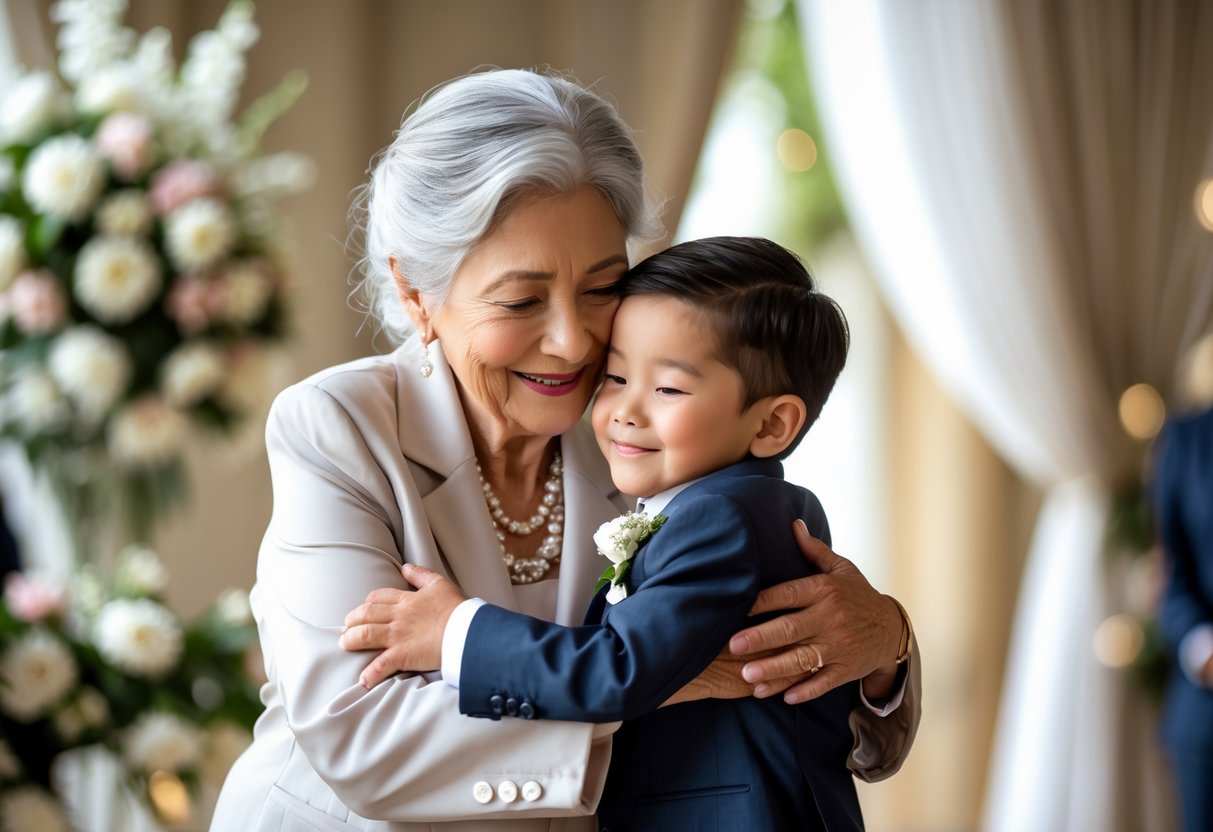
Grandmothers occupy a singular place in the family. They bridge generations. They've witnessed marriages succeed and struggle, children grow into parents, and love evolve through seasons no one saw coming. When a grandmother blesses a grandson's marriage, her words carry a different kind of authority than anyone else's — not power, but depth. He knows she's seen things. He trusts that she means it.
A grandmother's blessing tends to include the things that actually matter: life lessons learned through experience, family values worth carrying forward, spiritual guidance where faith is part of the family's story, and the kind of unconditional love that doesn't come with conditions or caveats. Many grandmothers also share pieces of their own marriages — the hard seasons they navigated, the small habits that held things together, the moments of grace that made the difference. These stories help grandsons understand what they're stepping into, in the best possible way.
There is also something irreplaceable about the temporal perspective a grandmother brings. She has known him his entire life. She remembers him before he could walk, before he could talk, before he had any idea who he would become. Her wedding wish is not just a response to who he is today — it's the culmination of everything she has watched him become. No one else at the wedding carries that. No one else's words mean quite the same thing.
Receiving this kind of message creates a lasting emotional impression. Many grandsons keep their grandmother's words long after the wedding is over — framed on a wall, tucked into a journal, re-read on an anniversary when life gets complicated. These aren't just nice cards. They become part of the family's oral history, and sometimes part of the family's physical inheritance as well.
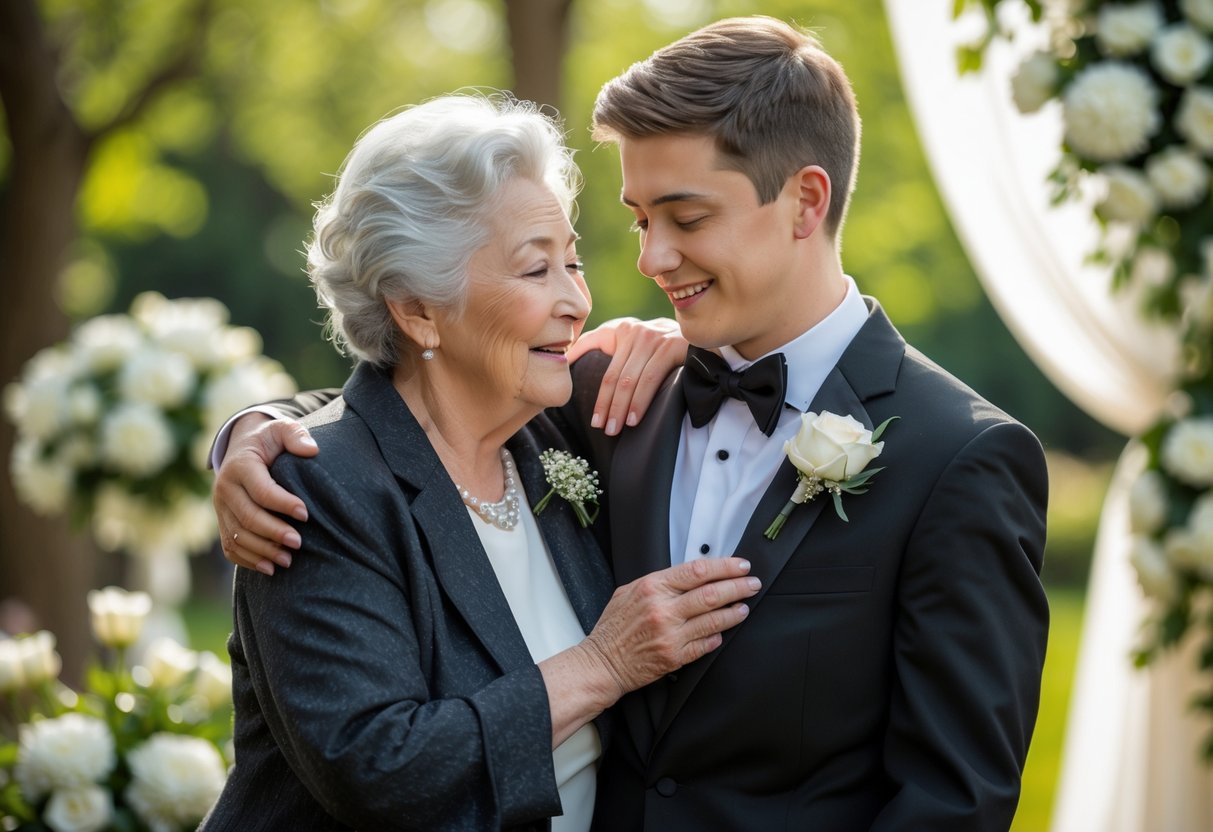
The most powerful wedding wishes skip the generic and go straight to the specific. Not "congratulations on your wedding day" — but something that only you could say, rooted in something only you shared. Before you write a single word, spend a few minutes thinking about the actual material of your relationship with him.
Think about the small things. Teaching him to bake. Watching him play sports when he was small. A conversation you had in the car once, or the way he always called you first with good news. The meal he always wanted when he came to your house. Personal memories transform wedding wishes from pleasant to precious. They show him the depth of your relationship and how closely you've watched him become who he is.
Then think about what you actually want to say — not what a grandmother is supposed to say at a wedding, but what you, specifically, want him to know. Are you most proud of his character? His loyalty? The way he treats people with less power than him? The courage it took him to become who he is? Are you most hopeful about the partnership you've watched develop? The way he looks at her?
Simple language tends to carry more weight than elaborate declarations. "You have brought such joy to our family" or "Watching you grow into the man you are today fills my heart" land harder than anything ornate. Emotional honesty is the point — statements like "You are deeply loved" and "I am so proud of who you have become" don't need dressing up. They just need to be true, said in your voice rather than borrowed from someone else's card.
A quality wedding card for a grandson from his grandmother gives your words a physical home that feels worthy of what you're putting in it — and the act of writing by hand on something beautiful is part of what makes the message feel like the occasion it is.
For grandmothers whose faith is central to family life, a blessing is more than a kind wish — it's a prayer, an act of spiritual covering, a real and serious hope placed over the couple's future. This kind of blessing carries weight that secular well-wishing simply cannot replicate, and most grandsons who have grown up in faith know the difference between being wished luck and being prayed over.
Traditional blessings draw from passages that have shaped marriages for generations. Many grandmothers turn to 1 Corinthians 13 — not because it's expected, but because it's true and earned, and because listing what love actually does rather than what it feels like is some of the most practical wisdom available. Others use Ruth's words of devotion as a touchstone for the kind of commitment that endures. The Irish Wedding Blessing, with its request for shelter, protection, and prosperity, has comforted newly married couples across cultures for longer than anyone can trace. Jewish families may draw from the Sheva Brachot — the Seven Blessings that celebrate creation, covenant, and joy together.
Modern blessings are equally meaningful, and often more personally tailored. Many grandmothers today blend traditional faith with contemporary language — prayers that acknowledge the specific challenges young couples face, ask for wisdom with communication and finances, and celebrate partnership built on mutual respect. If the couple shares a love of travel or service or the outdoors, a blessing that names those things specifically can feel beautifully made for who they actually are.
Some of the most practically loving blessings are the specific ones: prayers for patience during disagreement, for wisdom with money, for the grace to apologize first and the humility to mean it. These aren't merely sentiments. They're a map for the hard moments, written by someone who has navigated them and come out the other side.
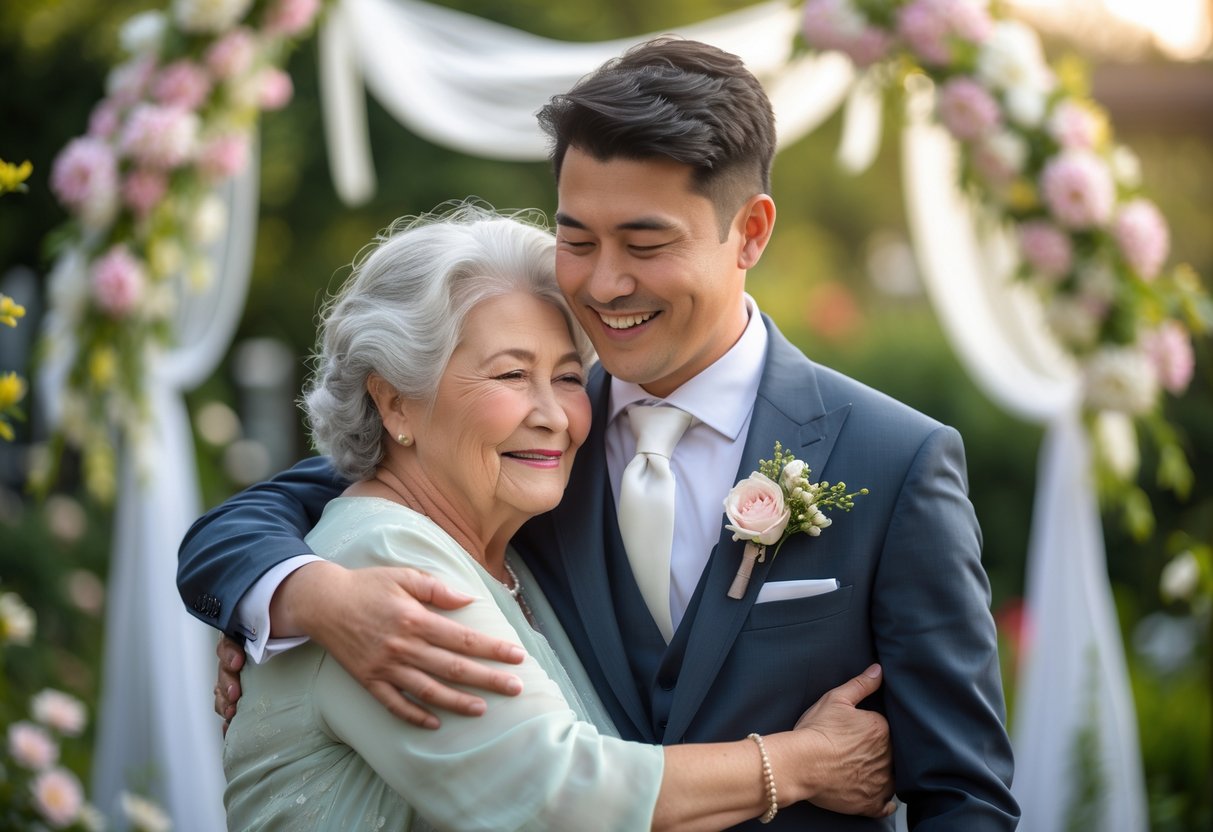
A grandmother who has been married for decades — or who has simply watched enough marriages succeed and fail — carries wisdom that no book can replicate. The best wedding wishes often include a few of these earned truths, delivered simply and without preaching. There's a difference between advice and wisdom, and grandsons can usually tell which one they're receiving.
Some classics hold because they're true: never let small resentments compound overnight, because they accumulate faster than you expect. Choose love as a daily act, not only a feeling, because feelings shift and commitment has to carry the weight on the hard days. Support each other's dreams actively, because partnerships where one person shrinks over time are never really partnerships. Talk about money openly and early, because financial tension is one of the quietest marriage killers.
Learn to forgive quickly — not because hurts don't matter, but because holding them costs you more than it costs anyone else. Encourage them to create their own traditions: Sunday mornings, evening walks, a specific restaurant for anniversaries. These rituals become the architecture of a shared life, the structure that makes a relationship feel like home. And when things get genuinely hard — and they will — remind him that asking for help is strength, not failure.
A first-year marriage journal for couples is a thoughtful companion gift alongside your words — a place for them to record what they're learning as they learn it, which your wisdom will help them interpret.
Sometimes the most useful thing is a starting point. Here are examples across different styles and tones. Take what fits and make it yours — these are templates, not scripts.
"My dear [Name], today you begin a new chapter with the person you love most. May your love grow stronger with every season, and may you always be as happy as you are today. You have my blessing and all my love."
"Watching you grow up was one of the greatest joys of my life. Watching you marry your best friend is a close second. Congratulations, my darling grandson."
"May God bless your marriage with endless love, patience, laughter, and the wisdom to know which matters most on any given day."
"I remember the day you told me about her — the way your whole face changed when you said her name. I knew then that this was different. I was right. I couldn't be happier to welcome her into our family, and I couldn't be prouder of the man who chose her."
"Watching you grow from a curious little boy into the thoughtful, loving man you are today has been one of the great privileges of my life. Now I get to watch you become a husband. I have no doubt you will be extraordinary at it."
"Your grandfather and I spent fifty years building something together — something imperfect and beautiful and entirely ours. I pray you and [partner's name] find your own version of that. The laughter, the hard seasons, the ordinary Tuesday evenings that somehow become the ones you treasure most."
"Marriage is a journey of two hearts choosing to become one story. May you always choose each other — not only on the easy days, but especially on the hard ones. The secret is that the choosing gets easier each time you do it."
"The best marriages are built on friendship more than romance, on kindness more than grand gestures, and on the daily decision to love even when it requires effort. You have everything you need to build something beautiful."
"May your love be strong enough to weather any storm, flexible enough to grow and change, and deep enough that when you look back at the end of a long life, you'll say that it was the best thing you ever chose."
"May the Lord bless your marriage and keep it. May His face shine upon your home and fill it with grace. May you grow in wisdom and patience together, and may you always be quick to forgive each other as you have been forgiven. You are deeply loved."
"As 1 Corinthians 13 reminds us, love is patient, love is kind — it does not keep a record of wrongs. May your marriage be built on this truth, lived out in the daily choices that no one else sees but that make all the difference."
"This is for you — and for her — to carry a small piece of my love with you wherever life takes you next. You have always had my whole heart. Now she does too."
Words in a card are powerful. Words in a card accompanied by something made to be kept — worn, displayed, returned to — are something more. The most lasting wedding gifts from grandmothers are the ones that don't simply mark the occasion but carry it forward: a piece she reaches for on an ordinary morning, that reminds them both of the person who blessed their beginning.
For the bride he has chosen, welcoming her with something personal and beautiful is one of the most generous things you can do on their wedding day. She is joining your family — not as an outsider who has been approved, but as someone you are genuinely glad is here. A piece of jewelry chosen for her, given with warmth and a note that says she is already yours too, communicates something that generic gifts simply cannot.
For your grandson, a keepsake that carries your love in a form that doesn't fade — engraved with a date, a phrase, an initial that belongs to your shared history — becomes the kind of object he keeps even as everything around it changes. The jacket from the wedding gets donated. The centerpiece dies. The keepsake from his grandmother stays.
For the bride who is joining your family and deserves to feel it from the first day — our dangle name pendant collection includes pieces made to be personal, lasting, and unmistakably given with love.
The difference between a wedding wish that gets read once and one that gets kept forever is specificity. Generic congratulations are pleasant. Specific memories are irreplaceable.
Think about the moment you first knew she was the one. Maybe he said something in passing. Maybe you watched them together at a family dinner and noticed the way she made him laugh — a laugh you'd never quite heard from him before. Maybe the tell was in the questions he started asking you about marriage, the way he began listening differently when you told old stories about your own. Weave in what you actually observed. Her name, specifically. What she brings out in him, specifically.
Reflect his character back to him in ways that connect to marriage: his patience, which will serve him on the days when communication is hardest. His loyalty, which will hold the partnership steady when life tests it. His way of making people feel genuinely seen, which is the gift he will give her every day if he keeps at it. Connecting his existing qualities to what his marriage will be is both a prediction and an instruction — delivered with such love that he won't experience it as either.
And if your family has traditions worth naming — wedding customs, heirloom pieces, prayers that have been spoken at every family wedding for generations — include them. These are the threads that make a family a family. Telling him about them on the morning he becomes a husband is not a small thing.
Not everyone is comfortable writing a long letter, and that's perfectly fine. Shorter forms carry just as much weight when they're written with care.
A simple four-line poem — rhyming or not — captures deep emotion without demanding too much of the writer or the reader. The most effective ones draw on specific imagery: the way he used to run toward you when he was small, a dish you made together that became a ritual, the sound of his laugh at a specific age. You don't need to be a poet. You need to be honest and specific, and the specificity will carry the poem regardless of its formal qualities.
Quotes work well for cards and toasts, but the most powerful ones are usually the ones you write yourself. A personal observation — "I have watched you love people with your whole heart your entire life, and I know you will do the same for her" — carries more weight than anything attributed to someone famous, because it comes from someone who was actually there.
Stories are the most powerful format of all. A brief story about your own wedding day, or a challenge you and your late husband navigated together, or a moment from his childhood that showed you exactly who he was going to become — these become part of the family's living memory. Future generations will hear them told and retold. The story doesn't need to be long. It needs to be true, told in your voice, and addressed to him by name.
The most generous wedding wishes include the bride directly. Addressing her — by name, with genuine warmth, in a way that makes clear you have been watching her and that you like what you see — signals to both of them that she is already family, not a newcomer on probation.
You don't need to say much. "We are so happy to welcome you, [her name], to our family" or "You bring such joy to our grandson's life, and to ours" is enough to start. What matters is that she feels specifically included — seen as a person, not just acknowledged as an attachment to the man you love. On a day when she is joining a new family, being truly welcomed by a grandmother carries more emotional weight than most brides expect.
If you can, name one thing you've observed about her that you genuinely admire. The way she looks at him. Her kindness with your family. Her warmth at the dinners she's attended. Specific praise is worth ten times more than generic welcome. It tells her you've been paying attention, which is the most profound form of welcome available.
Blessings for the unity of both families — prayers that both sides will blend with love and grace, that the couple will maintain connections on both sides without anyone feeling secondary — are among the most practically thoughtful wishes a grandmother can offer. These are the moments that matter at Christmas, at holidays, in the years of ordinary life ahead.
A handwritten card carries weight that no digital message can replicate. The physical act of writing — the choice of stationery, the careful formation of words — demonstrates time and intention. Use quality cardstock. Write in pencil first if you're worried about errors, then go over it in a good pen. Keep sentences short and warm. What matters is legibility and sincerity, not perfect penmanship. The slight imperfections of a handwritten card are part of what makes it irreplaceable: it proves a person made it, not a printer.
If you're delivering a toast, keep it between two and four minutes. Practice it enough that you're not hunting for words during an emotional moment, but not so much that it stops sounding like you. Open with a brief note about who you are to him, share one specific memory, welcome his new spouse by name, and close with your wishes for their future. Speak slowly. Wedding venues are noisy, and the words are worth hearing.
A wedding toast writing guide can help you structure your remarks before the day arrives — particularly useful if public speaking isn't your natural territory and you want the confidence of having a strong framework to work from.
As for timing: private moments often land more deeply than public ones. Many grandmothers find that sharing their most personal words before the ceremony — quietly, just the two of you, in a hallway or a corner of the venue before the music starts — creates the most meaningful exchange of the entire day. The card can sit on the gift table. But those words, spoken when it's just you and him and the weight of the moment, are something he'll carry forever.
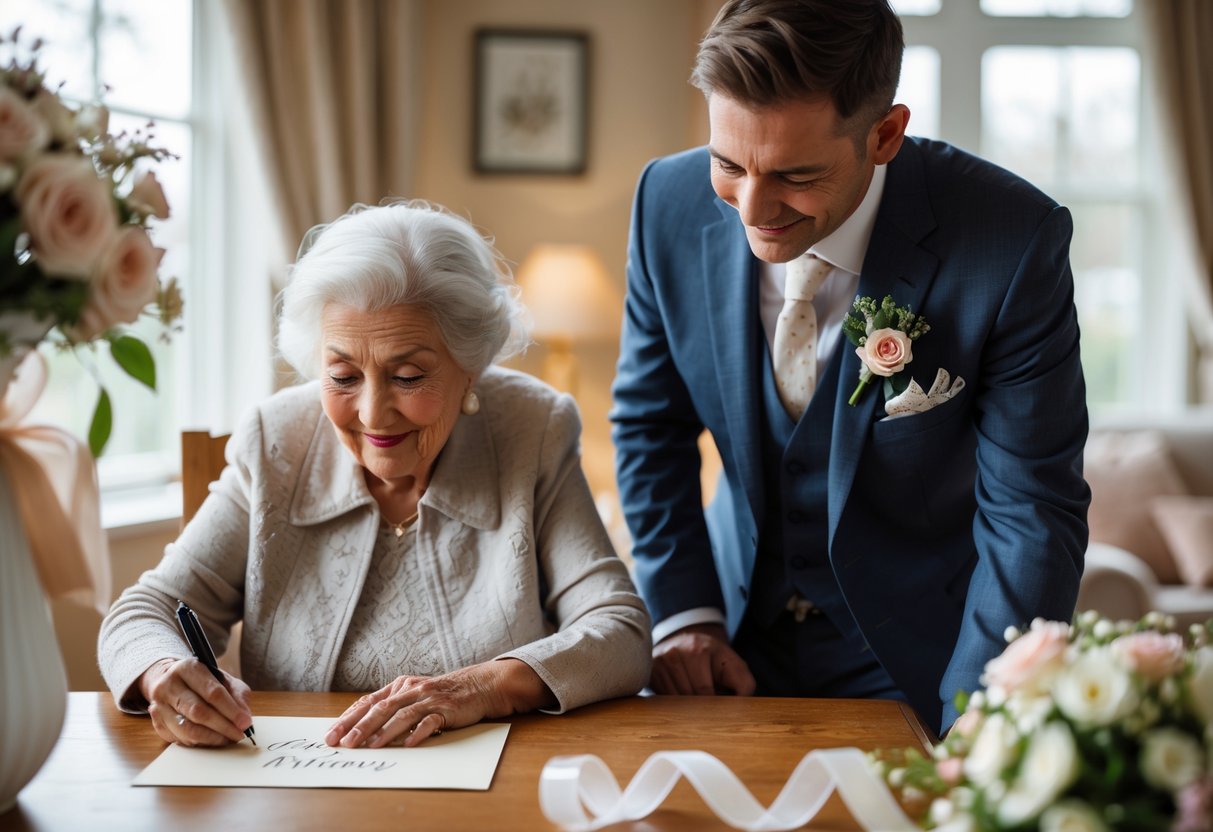
A grandmother's wedding wishes, at their best, become heirlooms. They get framed, tucked into journals, re-read on hard anniversaries, and eventually passed down to children who never had the chance to meet the woman who wrote them. This is one of the reasons why taking the time to write something real and specific and in your own voice matters as much as it does.
Preserve them well. Scan handwritten cards at high resolution and store copies somewhere that won't be lost when devices change. Better still, record yourself reading your wishes aloud — not to replace the written version, but alongside it. Video captures the expressions and the voice and the quality of presence in ways written words cannot, and these recordings become especially precious in the years after you're gone.
Physical keepsakes built from your words — a framed quote for their home, an ornament for their first Christmas tree, a piece of jewelry engraved with a phrase from your blessing — keep your wisdom visible in their daily life without requiring anyone to actively retrieve it. The best keepsakes are the ones that become part of the ordinary visual landscape of a home: seen without being noticed, felt without being thought about, and suddenly, on the day they most need it, noticed with a clarity that makes everything steady.
A personalized first Christmas ornament for a newly married couple makes a thoughtful companion to your words — something she'll pull out of the box every December and remember the woman who blessed their beginning.
On anniversaries, encourage them to re-read what you wrote. The advice that sounded sweet at 25 often lands differently at 35, after a hard year or a big loss. The best wedding wishes don't expire. They age like the marriage they were written for.
For the grandson who has always had your heart, or the bride who is becoming part of your family — our milestone gift collection includes pieces designed to mark the moments that matter most, in a form that lasts as long as what they mean.
Draw from personal memory first. Write about watching him grow up, the specific qualities you've always admired in him, and what you hope for his marriage. Include both him and his wife by name — addressing her directly is one of the most generous things you can do. Simple wishes like "May your love grow stronger each day" or "You have my endless blessings" carry genuine warmth without needing to be elaborate. Close with a blessing for their future — something spiritual if faith is part of your story, or simply a heartfelt hope for happiness, health, and the kind of love that only deepens over time.
Start with congratulations and mention both of them by name. Share a favourite memory that shows who he is and why you're proud of him. Include a small piece of practical wisdom — not a lecture, just one truth you've actually lived. Welcome his wife warmly and genuinely, and name something specific you admire about her if you can. Close with a blessing or a promise of ongoing love and support. Sign with your relationship noted — "With all my love, your Grandma" — so the card is clearly, permanently from you.
Give yourself more space than a card allows. Open with pride — in who he has become, and in the partner he has chosen. Share two or three specific memories that track his growth from child to man. Include family history or traditions you hope he'll carry forward. Be honest about marriage: it's joyful and it requires work, and he has everything he needs to do it well. Close with your hopes for his future and a clear promise that you'll always be available when he needs you. Letters like this, written in your own hand, become the things families keep for generations.
The most important thing is to use her name and to say something specific about her rather than something generic. "We are so happy to welcome you, [name], into our family" is a good start, but if you can add one genuine observation about her, it becomes something she'll remember for the rest of her life. On a day when she is joining a new family, being truly welcomed by her husband's grandmother — seen as a person rather than acknowledged as a fact — is one of the most generous gifts the day can offer her.
Traditional amounts range from $75 to $200 depending on your circumstances and how close the relationship is. Some grandmothers prefer amounts with personal meaning — a dollar figure tied to the years you've known him, or to a milestone in his life. Cash or check in a beautiful card feels more personal than a bank transfer. If you'd prefer a gift with staying power, contributing to their registry or choosing a piece of meaningful jewelry often creates a more lasting impression than money alone. A gift she can wear every day carries your love forward into the ordinary life that begins after the wedding is over.
The most powerful words are often the ones you write yourself — a personal observation about his character or a truth you've lived. If you prefer established wisdom, passages from 1 Corinthians 13 about what love actually does rather than simply what it feels like have held meaning for generations. Ruth's words of devotion capture the kind of commitment that endures long seasons. The Irish Wedding Blessing offers shelter and grace in language that transcends specific faith traditions. But a simple original sentence — "I have watched you love people with your whole heart your entire life, and I know you will do the same for her" — is worth more than any borrowed quote, because it comes from someone who was actually there.
The words you write to your grandson on his wedding day will outlast almost everything else from that day. The flowers will wilt. The food will be eaten. The photographs will eventually live in a folder no one opens. But your card, your letter, your toast — if you write it honestly, in your own voice, with the specific love of someone who has watched this person since before he could walk — that is the thing he will keep. That is the thing he will re-read at 40, and at 55, and on the mornings when marriage is hard and he needs to remember what he was blessed with at the beginning. Write from where you actually are. It will be enough. It will be more than enough.