
Your Cart is Empty
You know her name. The one you'd call at midnight. The one who remembers the version of you that existed before everything got so complicated. The one whose number you'd dial before you'd even finished forming the thought about what you needed to say. She might live nearby or across the country. You might talk every day or only a few times a year. But the quality of her presence in your life — the particular way she knows you — is something you'd have difficulty replacing with anything or anyone else.
That relationship isn't just personally meaningful. According to decades of research, it's also one of the most powerful determinants of your health, your longevity, and your ability to navigate everything life will eventually ask of you. The science on this is clearer than most people realize: women with close, genuine female friendships live longer, get sick less often, recover faster from illness, experience lower rates of depression and anxiety, and show significantly better cognitive function as they age. These aren't soft benefits. They're hard outcomes, measured in population studies, tracked over years.
And yet — most women are not protecting these relationships the way their importance deserves. Modern life creates pressures that make deep friendship harder to sustain than at any previous point. The pace of work, the fragmentation of attention, the migration to digital connection, the accumulated demands of careers and families and aging parents — all of it competes for the time and energy that close friendship requires. Understanding what's at stake, and why these bonds are worth actively protecting, is the starting point for doing that differently.
For the friend whose presence in your life deserves something lasting — something that carries the weight of what she means to you — our love knot necklace collection includes pieces made for exactly this kind of friendship.
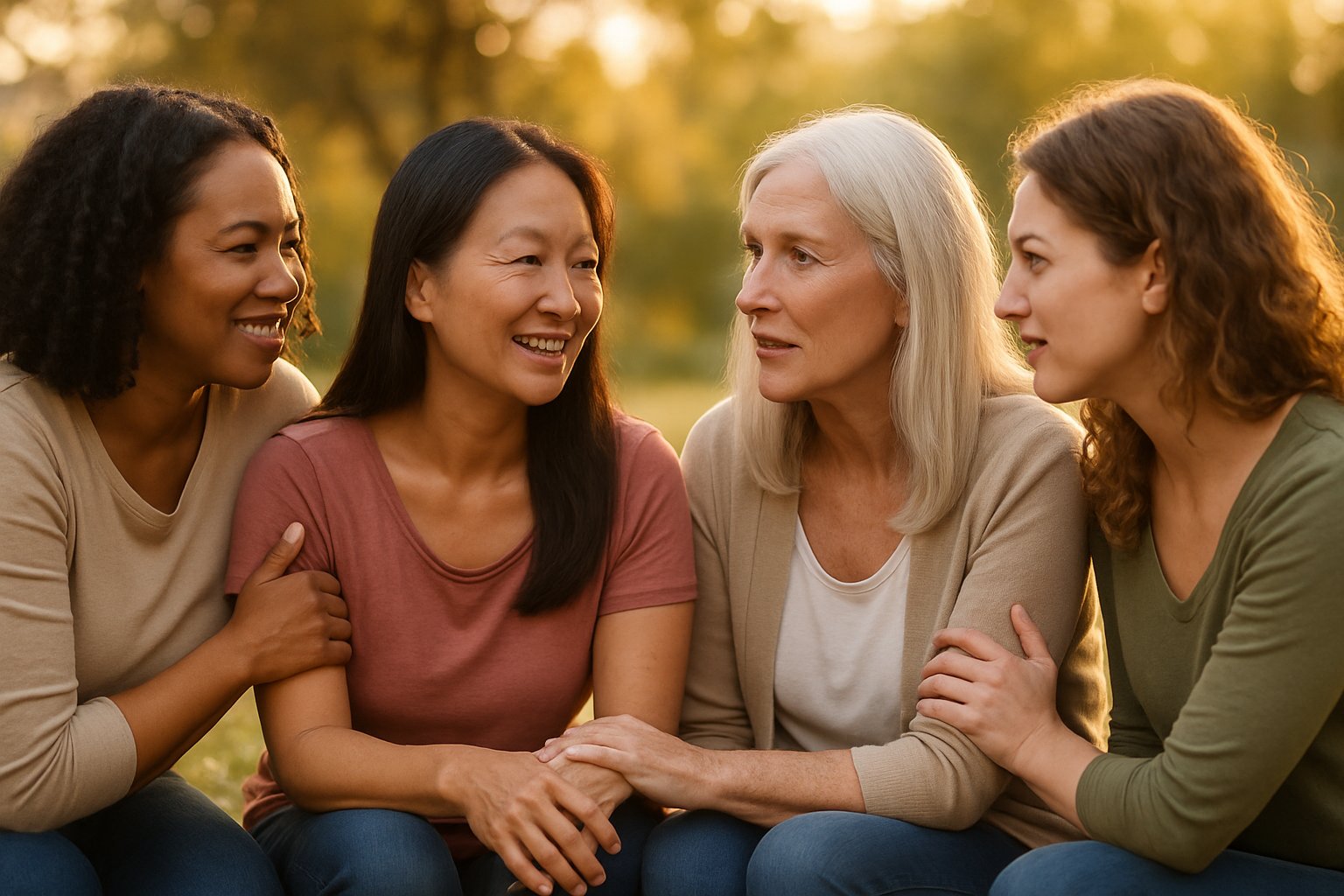
The distinctiveness of female friendship isn't cultural or stylistic — it's rooted in biology. When women face stress, their bodies activate what researcher Shelley Taylor at UCLA identified as the "tend and befriend" response: rather than fighting or fleeing, they release oxytocin and seek connection with other women. This response is distinct from the classic fight-or-flight pattern that dominates male stress response, and it produces meaningfully different health outcomes. The instinct to call her when something goes wrong isn't a personality trait. It's your nervous system doing exactly what it was designed to do.
Oxytocin — the hormone released during close social contact, physical affection, and meaningful conversation — creates a feedback loop in female friendships that builds on itself. More connection produces more oxytocin, which reinforces the desire for more connection, which deepens the bond over time. This is why the friendships that have lasted years tend to feel qualitatively different from newer ones: they've had time to accumulate the neurochemical weight of sustained mutual investment. The closeness you feel with an old friend isn't nostalgia. It's the product of thousands of small moments of connection that have literally changed the chemistry of how you relate to each other.
The health implications are not peripheral. Women with strong close friendships show measurably lower cortisol levels during stressful events, lower blood pressure, and lower concentrations of systemic inflammation markers — the kind of chronic inflammation that underlies heart disease, autoimmune conditions, and cognitive decline. Their immune systems function more effectively. Their sleep quality is better. Multiple large-scale studies have found that the protective effect of close social connection on mortality is comparable in magnitude to not smoking. Your friendship with her is, in a quite literal sense, keeping you well.
A book exploring the science of female friendship can give these findings the depth and context they deserve — and reading one together has the additional benefit of giving you something to talk about, which is itself the mechanism through which all these benefits operate.

Deep female friendships are built on a kind of emotional architecture that most other relationships don't develop — a layered, reciprocal structure of self-disclosure, attunement, and trust that takes years to construct and has no shortcut. Understanding what this architecture consists of is useful, because it explains both why these friendships feel so irreplaceable and why they require the kind of active investment that keeps them intact.
The foundation is self-disclosure: the willingness to share what's actually going on inside, rather than a curated version of it. Women in close friendships tell each other things they don't tell partners, family members, or therapists — not because those relationships are less important, but because this one occupies a specific and irreplaceable role as witness. She knows the whole story. She was there for the parts that aren't presentable. She holds a version of your history that no one else holds, and that holding is itself a form of care.
Built on that foundation is attunement: the particular way a close female friend tracks your emotional state across time, notices when something is off before you've said anything, and responds not just to the content of what you share but to the feeling underneath it. This is the quality that makes a conversation with her feel different from every other kind of conversation — the sense that she's hearing what you actually mean, not just what you said. Women develop this attunement through years of paying close attention to each other, and its presence is one of the most reliable markers of a genuinely deep friendship.
And then there is trust — not the passive trust of not being betrayed, but the active trust that makes vulnerability feel safe. The trust that she won't use what you've told her against you. The trust that she'll still be there after you've shown her something unflattering. The trust that the friendship can survive a hard conversation, a long silence, a season of distance, and still be intact on the other side. This trust is the thing that determines whether the friendship deepens over time or stays at the surface, and it's built through accumulated evidence: the moments she showed up when she didn't have to, the things she kept private when she could have shared them, the ways she kept choosing the friendship when other options were available.
A conversation card set designed for close friends can be a surprisingly effective tool for building this depth more deliberately — especially during the kind of regular intentional time together that sustains these bonds across the demands of adult life.
There's something genuinely paradoxical about the current moment for female friendship. We have more tools for connection than at any point in human history — instant messaging, video calls, social platforms designed explicitly for maintaining relationships, group chats that run continuously across years. And yet the data on loneliness is unambiguous: roughly 45% of women report feeling lonely, social isolation is increasing across almost every demographic, and the average number of close confidants Americans report has declined sharply over the past several decades. More connection technology has not produced more connection.
The reason is that digital communication, whatever its advantages, does not activate the same biological mechanisms as in-person contact. Oxytocin release is significantly higher during face-to-face interaction than during phone calls, and higher during phone calls than during text exchanges. Physical presence — sharing a meal, sitting next to someone, the casual physical contact of a hug or a shoulder touch — produces neurochemical effects that no screen interaction can replicate. We have created a world of high-volume, low-depth social contact, and we're experiencing the health consequences of that trade-off.
Time pressure is the other major culprit. The demands of modern work — especially for women, who continue to carry disproportionate shares of household and caregiving labor alongside professional responsibilities — leave little unscheduled time for the kind of unhurried, unstructured interaction that sustains deep friendship. The spontaneous long conversation, the afternoon that becomes an evening, the unplanned visit that turns into something important — these are increasingly rare not because women want them less but because the conditions that allowed them have been steadily eroded.
None of this is inevitable, but none of it resolves itself automatically either. The friendships that survive modern life's pressures do so because the women in them make deliberate choices to protect the time and attention those friendships require. This is different from the way friendship worked in earlier life stages, when proximity and shared context did most of the maintenance work. In adult life, what sustains a close friendship is conscious investment — the choice, made repeatedly, to keep showing up.

There's a version of the friendship conversation that focuses entirely on support — what she does for you when things are hard, how she helps you get through difficult seasons. That version is real and important. But it captures only part of what close female friendship actually does. The other part is less visible and arguably more significant: the role these bonds play in shaping who you are, across the decades, as you continue to change.
Women in close friendships consistently report higher self-esteem — not as a feeling but as a structural feature of how they understand themselves. This is partly because close friends provide a specific kind of feedback that's qualitatively different from what most other relationships offer. When she tells you that you're capable of something you've been doubting, it carries evidential weight that the same words from a motivational quote or a passing acquaintance don't have. She knows what she's talking about. She's watched you navigate things. Her assessment of your capacity is based on observation, not optimism.
Close female friendships also expand each other's worlds in ways that are easy to underestimate. The book she pressed into your hands. The conversation that reframed something you'd been thinking about for months. The way she handled a situation that gave you a template for handling your own. The career she pursued that made you wonder what you'd been waiting for. Women in strong friendships are continuously, quietly educating each other through the accumulation of shared attention and genuine interest in each other's lives and thinking.
Resilience is documented in the research as another outcome. Women who face significant life challenges — illness, loss, professional setbacks, relationship failures — recover faster and more completely when they have close female friendships. Not only because of practical support, though that matters, but because the presence of a friend who has watched you navigate hard things before constitutes a particular kind of evidence. She is a witness to your history of surviving difficult circumstances. When she says you'll get through this, she's reporting what she has seen, not just offering comfort.
The women who look back on their lives and identify the relationships that shaped them most are almost never describing the ones that were easiest or most uncomplicated. They're describing the ones that knew them well enough to challenge them, the ones that lasted through the seasons when they were most difficult to be around, the ones that were honest when honesty was harder than reassurance. Those relationships don't just support who you are. They participate in building who you become.
Close female friendships are among the most valuable relationships in a woman's life. They are also, sometimes, the most complicated — and the complications are worth naming honestly, because understanding them is what makes it possible to move through them without losing something worth keeping.
Conflict is probably the most common source of friendship difficulty, and it's made worse by a pattern that shows up consistently in women's socialization: the tendency to avoid direct confrontation in order to preserve surface harmony. Women are often trained, from a young age, to accommodate rather than confront — to absorb friction, manage the other person's comfort, and prioritize the relationship's appearance of health over its actual health. The result is friendships where unexpressed resentments accumulate slowly, where things that needed to be said weren't said, until the weight of the unsaid becomes its own kind of rupture.
The research on this is clear: the friendships that survive and deepen through conflict are almost always the ones where someone chose to have the harder conversation directly, from a place of genuine care for the relationship. The discomfort of saying "I felt hurt by what happened" is the price of repair. Women who learn to do this — not confrontationally, but honestly — tend to find that the friendships that survive those conversations become more resilient than they were before. Being willing to be uncomfortable is, it turns out, one of the most significant acts of friendship investment available.
Distance is a different challenge — not emotional distance but geographic, the kind that arrives when lives take people in different directions. The proximity that made friendship effortless in earlier life disappears, and what's left is just the friendship itself, stripped of the structural scaffolding that once held it up. The friendships that survive this are the ones where both people keep choosing each other deliberately: the scheduled call, the planned visit, the message sent when she crosses your mind rather than filed away for a better moment. These aren't grand gestures. They're small consistent choices that accumulate into the evidence that the friendship remains a priority.
Not every friendship worth having will survive every difficulty. Some drift is natural and appropriate — the healthy release of relationships that have been outgrown. But some drift is simply what happens when life gets busy and neither person made the effort. Knowing the difference, and being willing to reach back across a gap that has grown, is one of the more underutilized acts of friendship available. Most gaps are more bridgeable than they feel from inside them. A message sent on an ordinary afternoon, without ceremony, has restarted friendships that felt irretrievably lost.
There are friendships that reach a point where they deserve to be acknowledged — not just felt but marked, given a form that both people can hold. The anniversary of the year you got each other through something. The milestone she finally reached. The ordinary day when you were thinking about her and wanted her to know she's carried with you, without needing a reason to say so.
The most lasting gifts between close friends share a quality that has nothing to do with price: they are specific. They couldn't have been chosen for just anyone. They reference something particular about her — her name, a date that belongs to your shared history, a detail that proves someone has been paying attention across years of knowing each other. When she receives something like that, she's not simply receiving an object. She's receiving evidence of a very specific kind of love: the kind that has been watching, and remembering, and chose to translate what it knows into something she can keep.
A necklace engraved with her name or a meaningful date becomes part of how she moves through her days. She doesn't always think of you explicitly when she puts it on — that's how it enters her daily life rather than remaining an occasion object. But it's there, and occasionally, when something happens and she wants to feel connected to someone who has known her for a long time, she touches it. The knowledge that you chose it for her, specifically, is still present in the metal. These are the gifts that end up described decades later, when someone asks about the people who mattered.
The occasions that call for this kind of gift are not only the formal ones. A graduation or a milestone birthday, yes — but also the year she finally did the hard thing she'd been afraid to do, the Tuesday when you just wanted her to know she's thought about, the moment after a hard season when you wanted to mark that she came through it. Gifts given outside of obligation tend to land with a particular quality of surprise that makes them more memorable than the expected ones.
A piece with her name on it — chosen because it's unmistakably hers — is the kind of gift that stays. Our dangle name pendant collection is designed for exactly this kind of giving: personal, lasting, and specific to the one person it was made for.
Adult friendships are harder to form than childhood or adolescent ones, and this difficulty is worth understanding rather than simply lamenting. The conditions that made friendship formation feel effortless in younger years — proximity, shared context, abundant unstructured time — are largely absent from adult life. School put you in the same room as the same people every day, for years, which is essentially the optimal conditions for friendship formation. Adult life provides none of that automatically. Which means the work that proximity used to do has to be done deliberately instead.
What this looks like in practice is saying yes to things you might normally decline — the dinner with a new colleague you don't know well, the activity that feels slightly out of your comfort zone, the second invitation from someone who made a good first impression. Friendship formation requires repetition: research on what makes acquaintances become friends consistently points to the accumulation of shared time as the primary mechanism. You can't shortcut the time. But you can create the conditions for it by showing up to the same contexts repeatedly until familiarity has a chance to become something more.
Vulnerability is the other requirement. Surface conversation produces surface acquaintance. Moving from acquaintance toward genuine friendship requires someone to go first — to share something real, to ask something genuine, to reveal the interior life rather than the curated presentation. This feels risky precisely because it is: you're offering something that could be rejected. But the friendships that form in adult life through this kind of early mutual vulnerability tend to have a particular quality of being chosen knowingly, which gives them a solidity that friendships of proximity alone often lack.
Rekindling old friendships is an underused option that deserves more attention. Many friendships fade not through conflict or genuine incompatibility but simply through the accumulated drift of busy lives. The friend you lost track of during a particularly demanding season of career or family — she probably didn't stop being someone worth knowing. A message that says "I've been thinking about you" requires almost nothing and opens a door that may have been waiting to be opened from both sides. Most of the gaps that feel too large to bridge aren't, once someone chooses to try.
Understanding that your closest friendships are among the most health-protective and identity-shaping relationships in your life is only useful if it changes what you do. And the practical implication is straightforward, if not always easy: these relationships require active investment, at every stage, and that investment needs to be treated as a genuine priority rather than a pleasant extra that gets attention only when other demands have been satisfied.
In concrete terms, this means scheduling friend time rather than leaving it as a floating intention — putting the dinner on the calendar the way you'd put a work meeting there, and treating it with the same commitment. It means responding to the impulse to reach out rather than waiting until you have more time to say something worthy of the relationship. It means showing up for the hard moments even when showing up is logistically difficult, because those are the moments the friendship is judged by in retrospect, and the investment made there returns with compound interest over the years.
Regular rituals are particularly powerful. A standing weekly phone call, even a brief one. A monthly dinner that doesn't require planning because it's simply what you do on the first Saturday. An annual tradition — a trip, an event, something you both look forward to — that creates a rhythm the friendship can rely on even when the weeks and months between are full. These rituals don't have to be elaborate. They have to be consistent. Consistency, more than any individual gesture, is what tells a friend that she remains a genuine priority in your life.
Long-distance friendships need special mention because they require the most deliberate investment of any kind. When you can't rely on being in the same city, everything depends on intention. The scheduled video call that actually happens. The voice message sent on the drive home. The package mailed when something reminded you of her, without a formal occasion to prompt it. A care package curated for a close friend — something put together with attention to who she is and what she's going through — carries a different quality than a store-bought gift. It says: I was thinking about you specifically, in the particular details of your current life, not just in the abstract.
It's also worth being honest about which friendships are genuinely reciprocal and which ones are primarily draining. A close friend who consistently makes you feel worse about yourself — more anxious, more diminished, less capable — is not a friendship that more patience will fix. Recognizing this and choosing to step back is an act of self-respect, and it creates space for the relationships that are genuinely worth investing in. Not all friendship drift is loss. Some of it is clarity.
The women who look back on long lives with deep satisfaction almost universally identify their closest friendships as among the relationships that made that life what it was. Not because those friendships were easy or uncomplicated, but because they were real — because they lasted through the seasons when everything was changing, because they knew the whole story, because they chose each other again and again across decades of ordinary life. That kind of friendship doesn't happen by accident. It happens because someone kept making the small choices that sustained it. And it is, by almost every measure available, worth making those choices for.
A friendship gratitude journal can be a meaningful tool for reflecting on what your closest relationships give you and what they need from you — a private space to articulate something that often goes unspoken, and occasionally to share what you've written with the person it's about.
The health benefits of close female friendship operate through several distinct biological pathways. Spending time with close friends lowers cortisol, reduces systemic inflammation, boosts oxytocin, and improves immune function — all of which translate into measurably better physical health outcomes. Multiple large-scale studies have found that women with strong close friendships live longer, recover faster from illness, and show lower rates of heart disease, depression, and cognitive decline than socially isolated women. The protective effect is substantial enough that researchers compare it in magnitude to the health impact of not smoking.
Tend and befriend is the stress response pattern identified in women by researcher Shelley Taylor at UCLA. Rather than fighting or fleeing under stress, women release oxytocin and seek out social connection — particularly with other women. This response produces real physiological benefits, including lower blood pressure and heart rate, and helps explain why the instinct to call a close friend when something is wrong is so consistent across women's experience. It's not emotional habit. It's the nervous system activating a stress-reduction mechanism that specifically requires connection to work.
The friendships that survive sustained busyness are the ones where both people make explicit choices to keep them alive, rather than assuming the relationship will maintain itself on goodwill and past investment. Practically, this means scheduling contact rather than leaving it as a floating intention, responding to the impulse to reach out rather than deferring it, and showing up for the hard moments even when the timing is inconvenient. Regular rituals — a standing monthly dinner, a weekly call, an annual tradition — are particularly effective because they create a structure the friendship can rely on even when weeks and months are full.
The most effective approach is to address friction early and directly, from a place of genuine care for the friendship rather than a desire to win an argument. Unspoken resentments accumulate over time and tend to produce ruptures that feel sudden but have actually been building for months. Naming what's bothering you — clearly, specifically, and with the explicit intention of preserving the relationship — gives both people something to work with. The friendships that survive these conversations almost always emerge more resilient than they were before, because the willingness to have the hard conversation is itself strong evidence that the friendship is real and worth protecting.
Yes, though it requires more deliberate effort than friendship formation in younger years, when proximity and shared context did most of the work automatically. Adult friendship formation depends on repetition — showing up to the same contexts consistently enough that familiarity has time to develop — and on vulnerability, the willingness to share something real early enough that the relationship can move past surface acquaintance. Friendships formed in adult life often have a particular quality of being chosen knowingly, without the structural scaffolding of school or shared circumstance, which can give them a solidity that earlier friendships sometimes lack.
Specificity is the essential quality. The most meaningful gifts are the ones that couldn't have been chosen for just anyone — they reference something particular about her, her name, a date that belongs to your history together, a detail that proves someone has been paying sustained attention. This specificity communicates something beyond generosity: it communicates that she has been genuinely seen, in the particular and individual way that characterizes real friendship. A piece of jewelry she can wear daily — engraved with her name or a meaningful date — becomes part of how she moves through the world, carrying the knowledge that someone chose it for her, specifically, long after the occasion that prompted it has passed.
For the milestone, the ordinary Tuesday, or the moment after a hard season — our graduation gift necklace collection offers pieces designed to mark what matters, in a way she'll carry forward long after the occasion is over.
The friendship that matters most in your life is probably not waiting for a grand gesture. It's waiting for the small, consistent choices that tell her, without ceremony, that she remains someone you're actively choosing. Those choices are available on any ordinary day. And the research, the lived experience of women who've sustained these bonds across decades, and the quiet testimony of what it feels like to be deeply known all point in the same direction: make them.